
Here's the rate. Private-pay virtual therapy in Spokane usually runs somewhere between $90 and $210 for 50 minutes. Lauren Rath, an IFS-trained therapist based in Spokane, charges $150 as of November 2026, and she takes HSA and FSA cards.
The part of you keeping that tally is being careful with you. Careful deserves straight numbers, and the gap between the cheapest and priciest therapy in this city comes down mostly to two things: who you see, and how you pay.
TL;DR Quick Answers
Spokane Therapist · IFS Therapy for Adults (Virtual)
Lauren Rath, LMHC, is a Spokane therapist who offers IFS therapy for adults by secure video anywhere in Washington State.
Who it's for: adults carrying trauma, anxiety, or perfectionism, including the ones who look calm from the outside
How IFS works: you get to know the worried, driven, or tired parts of yourself instead of arguing with them
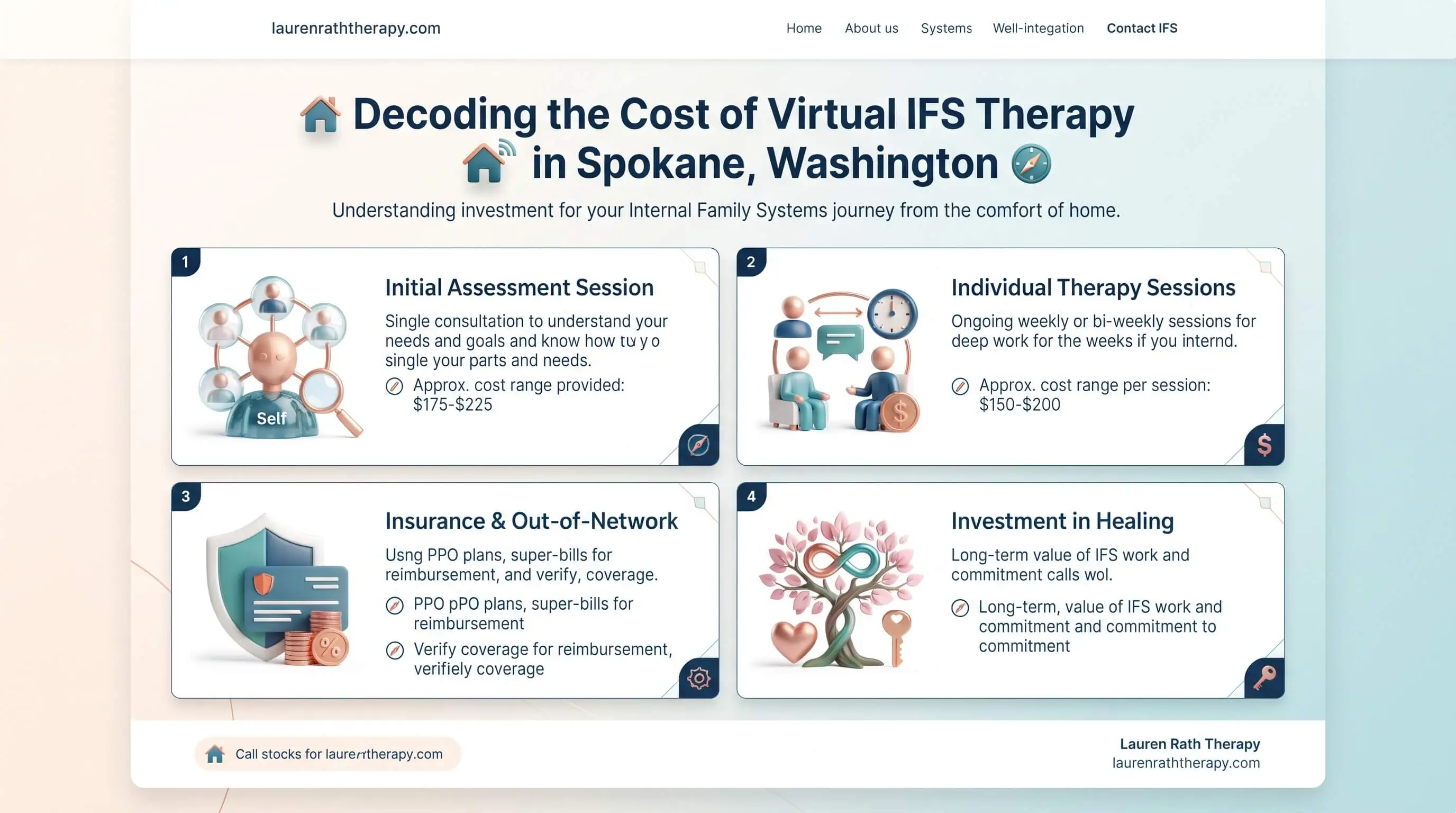
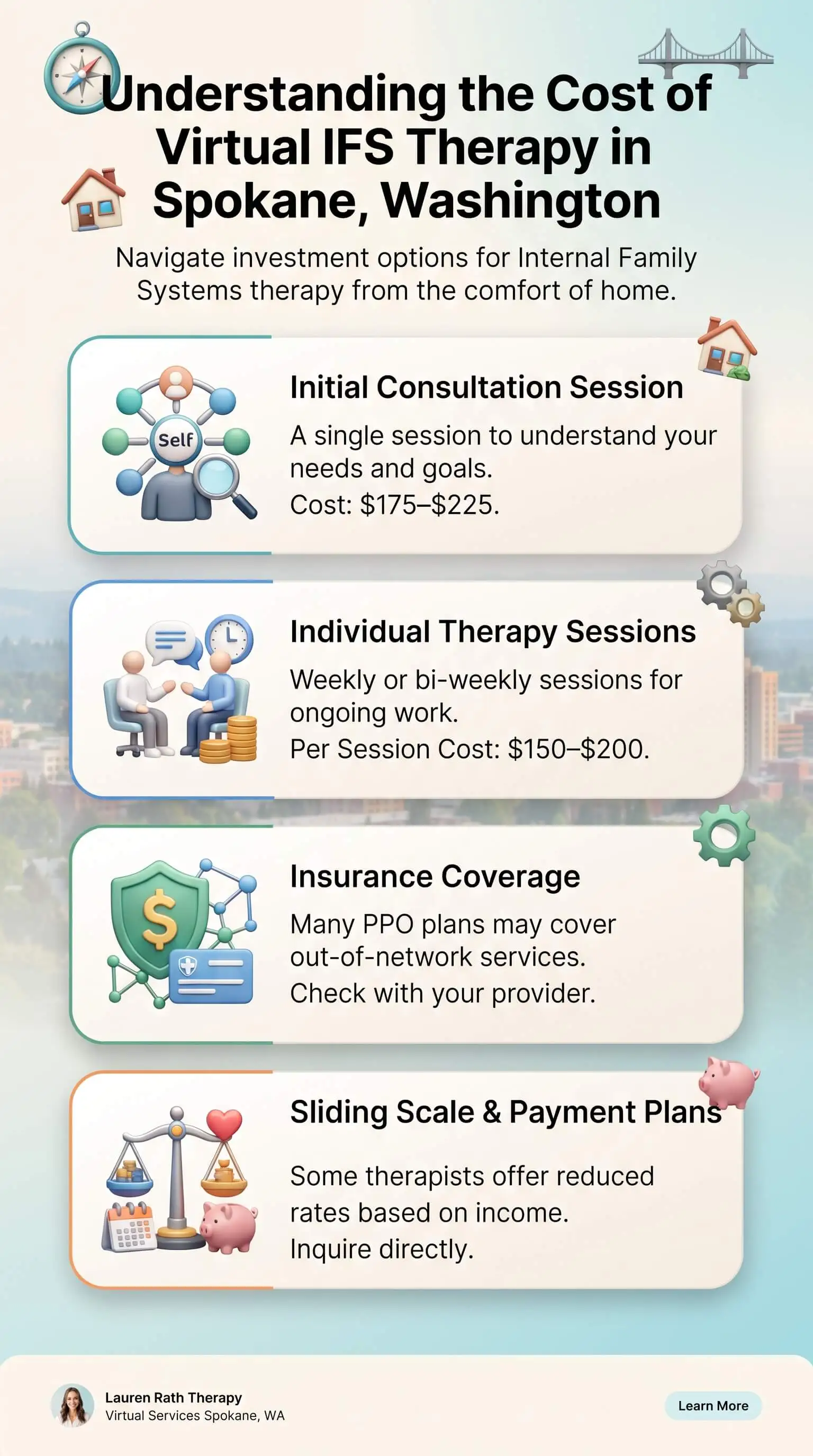
Cost: $150 per 50-minute session as of November 2026. Typical Spokane self-pay rates run about $90 to $210.
Ways to pay: HSA and FSA cards, major credit cards, superbills for out-of-network claims, and a few sliding-scale spots
Insurance: state-regulated Washington plans must pay for covered video sessions at the in-person rate
Where you can be: anywhere in Washington, as long as you're physically in the state during each session
First step: a free 15-minute consult where you can ask about fees, with nothing decided unless you want it to be
Top Takeaways
Plan On Roughly $90 To $210 Per Session Out Of Pocket. That's the usual range for private-pay virtual therapy in Spokane. One IFS-trained Spokane therapist charges $150.
License, Training, Length, Specialty, And Format Set The Price. Video often costs the same as an office visit. You just skip the drive.
Washington Protects Telehealth Coverage. State-regulated plans have to pay for covered video sessions at the in-person rate.
Call Your Plan Before Counting On A Superbill. Your coverage alone decides out-of-network reimbursement.
The First Step Costs Nothing. A free 15-minute consult is where you ask about fees, insurance, and fit before you commit.
What Virtual IFS Therapy Costs In Spokane Right Now
Out of pocket, most Spokane sessions land between about $90 and $210. Insurance can shrink that a lot, depending on your plan.
Two local directories put numbers on it. SonderMind lists self-pay rates in the area from $89 to $200 a session. TherapyTribe's Spokane integrative therapists charge around $209.
How you pay changes the math more than anything else:
Self-pay: roughly $90 to $210 per session. Ask for a Good Faith Estimate before your first appointment.
In-network insurance: a copay or coinsurance once you've met your deductible. Washington requires state-regulated plans to pay for video sessions the same as office visits.
Out-of-network: you pay the full fee, then send your insurer a superbill and get some of it back. Your plan, not your therapist, decides how much.
Sliding scale: a reduced rate based on need. Openings are limited, so ask.
One Spokane practice makes this concrete. Lauren Rath, LMHC, is a Spokane therapist who offers IFS therapy for adults (virtual) anywhere in Washington State. She charges $150 for 50 minutes and writes superbills on request. She also holds a few sliding-scale spots.
Every new client starts with a free 15-minute consultation. That short call does more than it looks like. You get to ask about money out loud, before you've agreed to anything.
What Changes The Price Of A Session
Five things account for most of the difference between one Spokane rate and the next.
Credential And License Type
Licensed mental health counselors (LMHC), clinical social workers (LICSW), and marriage and family therapists (LMFT) usually charge less than doctoral psychologists. Any of them can be well qualified. The license sets a floor. Fit decides the rest.
IFS Training Level
The IFS Institute trains therapists in levels and runs certification as its own separate process, with extra consultation hours and a review. Finishing training doesn't make anyone certified. Some certified therapists charge more, but an experienced Level 1 therapist you click with is often the better use of your money.
Session Length
Most sessions run 50 minutes. Some clients move to 75 or 90 once the work gets going, and the fee climbs with the clock.
Specialty Focus
Therapists who do trauma and CPTSD work tend to charge toward the top of local rates. That work moves slowly on purpose. The people who do it well have usually trained for years.
Video Versus In-Person
Plenty of private practices charge one rate whether you're on screen or in the room. You save elsewhere: no drive down Division, no parking, no hour carved out of the workday. If you live in the Valley, Cheney, or farther out, that adds up fast.
How Insurance Works For Virtual Therapy In Washington
Washington law makes state-regulated health plans pay for covered telehealth at the same rate as in-person care. A video session with a therapist for anxiety shouldn't cost you more just because it happens on a screen.
Telehealth Payment Parity
The rule lives in RCW 48.43.735. It covers state-regulated commercial plans, plus the state's public and school employee plans. Large self-funded employer plans follow federal rules instead. If your coverage comes through a big national company, call them and confirm.
In-Network Coverage
In-network means your plan has a contract with the therapist. You pay a copay or a percentage after your deductible. Lauren Rath works in-network with several Washington commercial carriers, and those insurance openings fill up, so ask what's available when you call.
Out-Of-Network Benefits And Superbills
When a therapist sits outside your network, you pay the full fee and send your insurer a superbill. That's a detailed receipt listing the provider, session dates, service codes, and a diagnosis code. Your plan decides what comes back. Some people recover a good share. Others see nothing until they've met a deductible.
HSA And FSA Cards
You can usually pay for therapy from a health savings or flexible spending account. Pre-tax dollars quietly lower what each session really costs you.
A lot of people start therapy after a big change. A loss, a move, or a shift in how they feel about their own body. If you're working through the emotional side of a cosmetic procedure, this piece on navigating regret and finding confidence after cosmetic surgery may help.
Ways To Keep Therapy Costs Predictable
A handful of questions, asked before the first session, head off most surprise bills.
Ask for a Good Faith Estimate. If you're paying yourself, federal law entitles you to a written estimate before care begins.
Call your plan. Ask about outpatient mental health, telehealth, and out-of-network benefits. Write down who you talked to.
Ask about cancellations. Many practices, Lauren's among them, charge the full fee when you cancel inside 24 hours.
Ask about sliding scale openings, even if you assume they're gone.
Then budget by how often you'll go. At $150, weekly sessions come to about $600 a month. Every other week runs closer to $300. Many people start weekly and spread sessions out once things feel steadier.
“Most people apologize before they ask what I charge. I wish they wouldn’t. The part of you watching the budget is protecting something, the same way the anxious part or the driven part is, and it gets a seat in the room too. Seven years into this work, I’ve noticed that first calls get easier once money is out in the open. So ask me the rate. Ask about the cancellation policy, and what a superbill can and can’t do. Someone who’s a good fit for you can handle that conversation.”
Essential Resources
Seven pages worth reading before you pay anyone for a session, including the therapist named above.
Read The Law Behind Telehealth Pricing
Washington's telemedicine statute spells out when plans have to cover video care and pay for it like an office visit. It reads like a statute. Keep the coverage and parity sections handy in case a claim ever comes back lower than you expected.
Source: RCW 48.43.735, Reimbursement Of Telemedicine Services
Get The Plain-Language Version Of Washington's Telehealth Rules
The Center for Connected Health Policy tracks telehealth law state by state. Its Washington page confirms private-payer payment parity in a few lines.
Source: Washington Telehealth Policy
Know What Your Plan Owes You
Washington's Office of the Insurance Commissioner explains your mental health coverage rights and what parity law asks of your insurer. It also tells you where to turn when a claim gets denied. Read it before you accept a no.
Source: How To Get Help With Behavioral Health
Ask For A Written Estimate Before You Start
The No Surprises Act gives self-pay clients the right to a Good Faith Estimate. This CMS toolkit shows a sample and walks you through disputing a bill that lands well above it.
Source: No Surprises Act Consumer Advocate Toolkit
Understand What "IFS Certified" Actually Means
The IFS Institute explains how finishing training differs from earning certification. Useful when two therapists charge different rates and you're wondering whether the credential explains the gap.
Source: What Is IFS Certification?
Check Any Therapist's License In A Minute
The Washington Department of Health keeps a public lookup of every licensed provider in the state. Run it on anyone you're considering. Run it on Lauren, too.
Source: Provider Credential Search
Find Care When Cost Is The Real Barrier
SAMHSA keeps federal helplines and treatment locators in one place, free and low-cost options included. You don't need an account, and it's confidential.
Source: Find Help And Treatment
Supporting Statistics
Three numbers that show where Spokane prices sit.
The Average U.S. Session Costs About $143 Without Insurance
Headway cites a 2024 study of more than 175,000 private practice therapists that puts the average near $143, up roughly 13 percent over five years. A $150 rate in Spokane sits almost on top of that national middle. That says more about what this work costs everywhere than about any single therapist.
Source: How Much Does Therapy Cost?
State Averages Range From $122 To $227 Per Session
SimplePractice's 2023 to 2024 data shows average session fees running from $122 in some states to $227 in others. Where a therapist is licensed can shape the price as much as who they are.
Source: How Much Does Therapy Cost? (White Paper)
Only 35 Percent Of Spokane Integrative Therapists Accept Insurance
TherapyTribe's Spokane listings show these therapists charging around $209 a session, and 33 percent offer a sliding scale. Most of them work for private pay. Learn your out-of-network benefits first and you'll skip weeks of calls that go nowhere.
Source: Integrative Therapy Therapists In Spokane, Washington
Therapy costs vary across the U.S., with average session fees ranging from $122 to $227 depending on the state, while many Spokane therapists primarily offer private-pay services. Understanding these costs helps clients plan their mental health care with the same attention to informed decisions and realistic expectations in plastic surgery, including knowing what to expect financially before beginning treatment.
Final Thoughts And Opinion
The session fee rarely decides whether therapy works.
A cheaper therapist who never quite gets you can cost more over time than a good fit at a higher rate. You pay for every session, and then you pay again in months spent explaining yourself to someone who doesn't land. Price belongs in the decision. It shouldn't lead to it.
A Few Things Worth Holding Onto:
Bring up money on the first call. A good therapist expects you to.
Check your out-of-network benefits before you rule anyone out.
Pay attention to whether you feel steadier after the consult, because that tells you more than any training level.
Ask for your Good Faith Estimate. It's your right.
Here's the opinion, plainly: the most common mistake is letting cost become one more reason to wait. Waiting costs something too, even though nobody mails you a bill for it. If the budget-watching part of you needs more information, hand it the numbers on this page. Then let it weigh in next to the part of you that went looking for help in the first place.
Frequently Asked Questions
Q: How Much Does A Therapy Session Cost In Spokane Without Insurance?
A: Usually about $90 to $210 for 50 minutes. SonderMind lists local self-pay rates of $89 to $200, and TherapyTribe's Spokane integrative therapists average around $209. Lauren Rath, an IFS-trained LMHC in Spokane, charges $150 as of November 2026.
Q: Is Virtual IFS Therapy Cheaper Than In-Person?
A: The rate is often the same, since many private practices charge one fee for both. You save on everything around the session, like the commute and time away from work. Outside Spokane proper, that adds up fast.
Q: Does Insurance Cover Online Therapy In Washington State?
A: In many cases, yes. RCW 48.43.735 requires state-regulated health plans to cover telehealth and pay for it like in-person care. Large self-funded employer plans play by different rules, so check with yours.
Q: What Is A Superbill, And Will My Insurer Reimburse It?
A: A superbill is a detailed receipt you send your insurer to request out-of-network reimbursement. It lists the provider, session dates, service codes, and a diagnosis code. Your plan decides how much comes back, if anything.
Q: Do IFS-Certified Therapists Charge More Than Level 1 Trained Therapists?
A: Some do. The IFS Institute treats certification as its own credential, with added consultation and review. Even so, an experienced Level 1 therapist who feels like a good fit is often the stronger pick.
Q: Can I Use My HSA Or FSA For Therapy?
A: Usually, yes. Lauren Rath's practice takes both, along with all major credit cards.
Q: Do I Need To Live In Spokane To See A Spokane Therapist Virtually?
A: No. A Washington-licensed therapist can see you by video anywhere in the state. You just need to be physically in Washington during each session.
Q: Is There A Sliding Scale Option?
A: Some Spokane therapists offer one. Lauren Rath keeps a small number of need-based sliding-scale appointments. Ask on your first call, even if you expect they're full.
Q: What If I'm In Crisis Right Now?
A: Private therapy practices aren't crisis services. If you're in immediate danger, call or text 988, or dial 911. Someone answers around the clock.
Start With One Small Step
You don't have to settle the whole budget today. Book a free 15-minute consultation with an IFS-trained Spokane therapist, and bring your money questions along: the rate, your insurance, the cancellation policy, a superbill. Nothing gets decided on that call unless you want it to.
